By Lauriane Bradford, London
Very little remains of Brussels’ medieval past. Founded in the 10th century on the banks of the River Zenne, the city became the capital of Belgium when the country gained its independence in 1830.
Following independence, the newly established capital underwent major transformations to become a modern, elegant, and comfortable city inspired by Haussmann’s Paris. The polluted and non-navigable Zenne was covered over and replaced by a canal linking Antwerp and Charleroi. At the same time, in response to the Industrial Revolution and influenced by the International and Universal Exhibitions, new architectural movements such as Arts and Crafts, Art Nouveau, and later Art Deco emerged across Europe in the late 19th century. In Brussels, where demand for hôtels particuliers and townhouses was growing, architects Victor Horta and Paul Hankar were able to give free rein to their imagination.
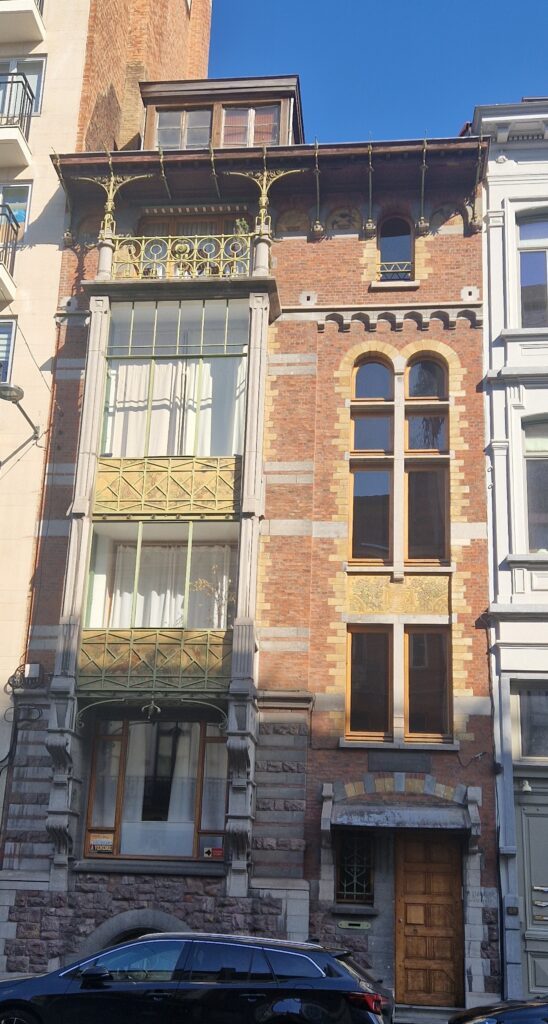
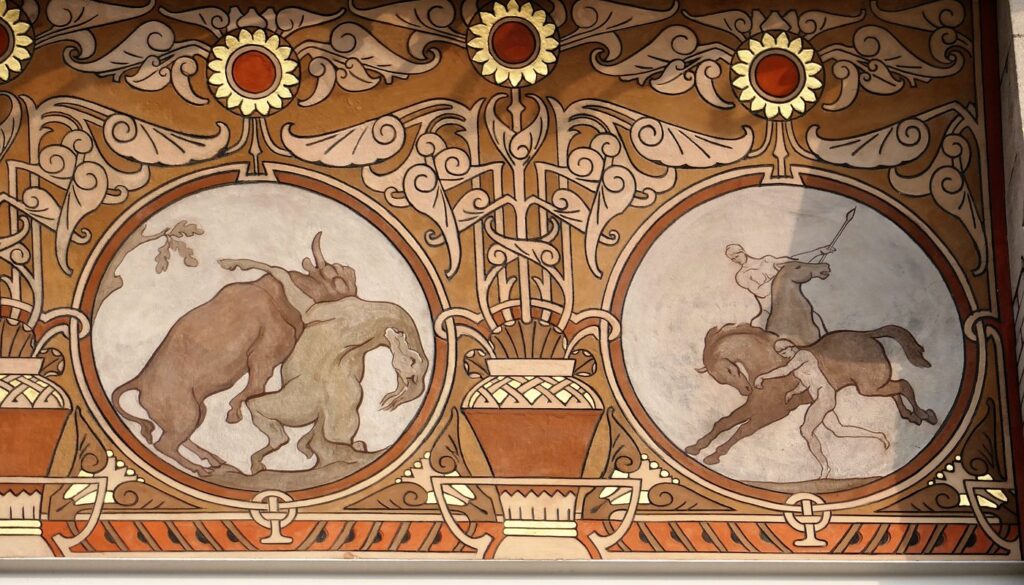
Our walk on the outskirts of the city took us to some of the finest examples of Art Nouveau and Art Deco architecture in the Ixelles district. We began at the Hôtel Albert Ciamberlani, built by Paul Hankar in 1897 for the mother of the Symbolist painter Albert Ciamberlani. With its two large windows and impressive allegorical sgraffito by Ciamberlani himself, the house now serves as the residence of the Argentine Embassy.
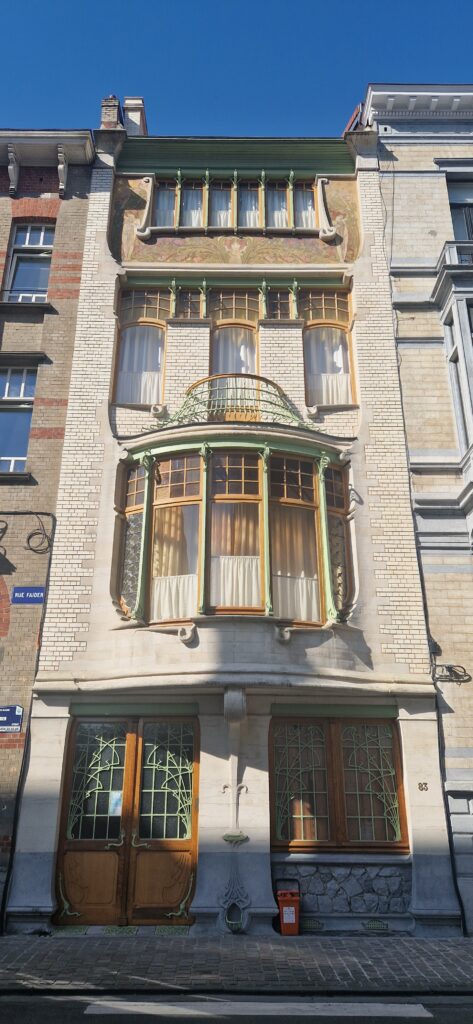
A short distance away stands Hankar’s own house, regarded as one of the first Art Nouveau buildings in Brussels. Influenced by Viollet-le-Duc and William Morris, Hankar experimented creatively with materials such as metal and glass while incorporating elements of the Neo-Renaissance style. As we walked through the neighbourhood, our guide drew our attention to the many architectural and decorative details adorning both private houses and commercial buildings.
Brussels’ Art Nouveau heritage was further illustrated by the striking Maison Roosenboom, designed by the architect Albert Roosenboom in 1900. Its blue and white stone façade, elegant bow windows, exquisite detailing, and magnificent sgraffito make it a masterpiece of the Art Nouveau movement. While admiring this splendid building, we were surprised to learn that Roosenboom later came to reject and even despise the style.
An even more celebrated example of Art Nouveau is the Solvay Townhouse, commissioned by the industrialist Armand Solvay from Victor Horta. Widely regarded as one of the finest Art Nouveau residences in the world, it features stained-glass windows, a magnificent staircase, and lavish interior decoration. After initially being disappointed that we would not be able to visit any of the houses, which were either private residences, under renovation, or not included in the tour, our luck changed, and some of us managed to book a visit to the Solvay House. Armand Solvay gave Horta an unlimited budget, and the result is breathtaking. For those who have visited both, the Horta Museum seems comparatively modest and less inspiring.
The final section of our walk returned to Art Deco beginning with a visit to the Church of the Holy Cross and finishing at the Abbaye de la Cambre, a former Cistercian abbey that was badly damaged during the Wars of Religion. The medieval complex was rebuilt in the 17th century and redesigned in later periods. The medieval church and cloister still stand in the middle of this affluent green area.
This walk gave us a little taste of Brussels’ architectural gems and an invitation to return, as there is still so much to see.